Monday, June 22, 2015

Incan Adventure in Peru!

Day 1 - Kicking Off Our Incan Adventure in Lima

Our flight from DFW arrived in Lima early in the morning, which felt a little strange since the city is in the same time zone as home! We planned ahead and booked our hotel room for the previous night so we'd have a place to crash after arriving in Peru. We stayed at the quaint Hotel Antigua in Lima's Miraflores District. It's built in an old colonial mansion and is full of stairwells, mysterious doorways, and interesting nooks and crannies. It's a taxi ride from there to the city center, but the Miraflores neighborhood has many restaurants, clubs and bars, and is full of life after the sun goes down.


The Cathedral of Lima overlooks Plaza Mayor
After a couple hours of rest, we headed into Lima, straight to the city center at Plaza Mayor. Since it was Sunday, Bill and I thought it might be a bit sleepy in the city, with maybe just a few shops open for tourists near the square. We couldn't have been more mistaken! Our visit to the square coincided with the celebration of the anniversary of Jauja, a city and region in central Peru. The streets were flooded with hundreds of dancers and musicians performing "La Tunantada," a colorful and noisy festival that both celebrates favorite patron saints and pokes some fun at the Spanish (Peru's former occupiers). It was amazing! From the cathedral facing the square, there were also numerous floats, or platforms, with statues of religious icons and saints. One after the next, they would emerge from the cathedral doors, carried (precariously) down the steps on the arms and shoulders of men... Out into the street, they would turn to bow to the cathedral and the cross, and then enter the processional of the parade. Each float had a group of elaborately costumed dancers and marching bands following behind.


Pilgrims carry a float down the cathedral steps
Celebrants on the Plaza Mayor
It was quite a spectacle! In addition, there was a live concert that followed the parade, and a festive atmosphere everywhere we looked. We took a little time to explore the streets around Plaza Mayor, window shop, and grab some lunch. You won't see many name-brand stores you're familiar with, but all of Peru's big department stores are here, and the shopping promenades were full of Sunday shoppers and revelers. It was an experience we would have missed if we hadn't taken a chance and headed into the city!

I made a new friend!
Day 2 - Into the Sacred Valley

We woke up early to catch our flight from Lima to Cusco, and hopped on our bus to begin our Incan Adventure! We drove through the city on the way to the Sacred Valley, and caught a glimpse of some of the sights we'll see later in the week. 

Our first stop was at Ccaccacollo Community, home to the Peru Women's Weaving Co-op, sponsored by the Planeterra Foundation. Their goal is to provide a viable economic livelihood through weaving, for the community's women to supplement their limited, traditional agricultural income. One of the community's residents, Lucia, joined us on the bus as we drove to the community square. where we were first greeted by a tiny little boy dressed in a traditional knit cap, so adorable.


Our Ccaccacollo welcoming committee! So cute!
Lucia brought our group to the weaving area, where the women stood spinning wool (from llamas, sheep and alpacas that they raise). It is an art that has been passed down for centuries. We learned how they turn the rough wool into the soft thread for weaving and my favorite was seeing the natural ingredients used to create the vibrant colors. They use everything from local plants, flowers, and even dried insects.


Ccaccacollo women demonstrate the spinning of wool
Freshly dyed wool waiting to be woven
A woman demonstrates the centuries-old weaving technique
After seeing how it was done, it was time to shop. From rough wool to the softest scarves, bags, hats and socks you've ever felt. We definitely did our part to support their community by buying many treasures to take home.

We next headed for the site of the Incan ruins at Pisac. Researchers believe it was built in the 15th century, and had military, religious and agricultural buildings. Pisac is still home to some of the famous Incan terraces, used to grow surplus food for the growing empire. When we arrived, the skies opened up and it began to pour. Our group glumly put on their rain gear for the walk up to the viewing area, and then, lo and behold, the sun peeked out and two beautiful rainbows stretched out across the valley below us. We couldn't take photos fast enough... It was stunning!


Double rainbows at Pisac
After taking in the stunning natural beauty, we headed to our next stop. We ate our late lunch of authentic Peruvian cuisine at Parwa Community Restaurant, another Planeterra Foundation project. We sampled delicious traditional food, including locally-grown quinoa, quail eggs, peppers, and more. It was an Incan feast! After stuffing ourselves, we headed to our hotel in the riverside town of Urubamba. It was a full day, and a great taste of things to come on our Incan adventure!

Day 3 - In the Footsteps of Kings

We started the day with breakfast at our hotel, the charming San Agustín. It's a hidden gem in the otherwise dusty workaday town of Urubamba. 

We headed out for the Incan ruins at Ollantaytambo, a breathtaking series of terraces and buildings carved into the Patakancha River valley. During the Incan Empire, the location was the royal estate of Emperor Pachacuti, who built many elaborate residential and ceremonial structures on the site worthy of a kingly home. We grabbed our cameras and made the climb to the top, stopping once in a while to catch our breath and learn a bit about the site from our awesome guide, Jose. It was a gorgeous day, and turning around to snap photos of the valley below was fantastic.


The Incan ruins at Ollantaytambo
From there, we drove to the site of the pre-Incan saltworks of Las Salineras. The drive down from the tops of the hills overlooking Urubamba was an adventure in and of itself. Our bus driver, Miguel, was the hero of the day, carefully navigating switchbacks, one-lane bridges, and mountainside traffic jams.

Las Salineras was like something from another planet... From above, it looks like a sea of white "cells," each an individual salt pool, about 3,000 total. Fed from the nearby mountain stream, each pool is filled with about 5 cm of water, and then allowed to evaporate, leaving the salt deposits behind. The process is repeated until the pool is full with salt. It is then scraped clean and the salt is carried by hand away for processing. Some men were scraping their plot while we were there, it was really interesting to watch the process. We wandered out into the salt pools for some photos, and to dip our fingers in the stream... Sure enough, after a minute in the sun, you're left with salt on your fingers!


The salt pools of Las Salineras
Salt crystals cake the sides of the channels that fill the pools
Afterward, we made a stop at the Incan ruins at Moray. An agricultural center, Moray features three series of "crop circles," enormous circular terraces carved into the landscape. Researchers believe that Moray was an Incan agricultural laboratory, with each level of the terraced circles providing a slightly different climate than the ones above and below. 


Crop circles at Moray
We headed back to Urubamba, for a delicious lunch of Peruvian cuisine at Pachamanca Restaurant in the center of town. The signature dish is Pachamanca, or "earth pot," a delicious stew of chicken, pork and vegetables cooked in an earthen pot. Wonderful, and a perfect cap to our last day in the Sacred Valley.

Day 4 - Aguas Calientes

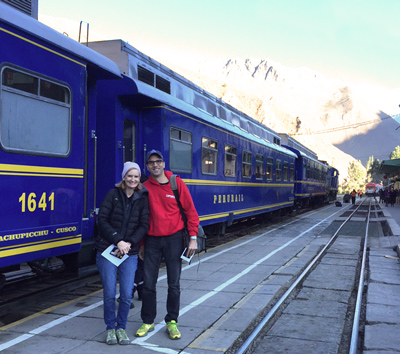
We woke up early to catch our bus to the train station at Ollantaytambo. There we boarded the Peru Rail train to Aguas Calientes, or Machu Picchu Pueblo (town), at the foot of the famous mountain. The town is only accessible by rail, so the railroad is the town's lifeline to Cusco and the rest of the country... All food and other supplies reach the town by train.


All aboard!
The train ride is an attraction in and of itself! The cars are clean and comfortable, and each has large picture windows on the side and top to view the incredible mountain scenery. The journey makes its way up to Aguas Calientes alongside the Rio Vilcanota, complete with roaring rapids and breathtaking vistas as both river and train wind through the dramatic landscape on both sides.


A typical view from the train ride to Aguas Calientes
We arrived in the town to find a charming tourist village perched on the hillside beneath the famous Andean peaks that are home to the most famous of Incan sites. We walked from the train station up the hill toward our hotel... Walked, as everyone does, because there are no cars in Aguas Calientes! The only motor vehicles you'll see here are the motor coaches that make the constant round trip up the mountain to Machu Picchu. So, while pulling our rolling suitcases up the hill might have seemed tiring, watching the local porters hauling immense loads of food, construction materials, you name it, up the steeps hills made us appreciate our small bags.


Downtown Aguas Calientes
It was too early for check in, so we put on our bathing suits and headed for the natural hot baths (baños termales) that give the town its name. A short walk from the top of the hill in town, the small facility has a handful of small pools for soaking and relaxation. While not the most elaborate bathing facility, it's a popular spot for families and trekkers recovering from their hikes on the Inca Trail and Machu Picchu.

After a quick shower, and a little time on the surprisingly fast internet we headed out to explore the quaint town. We quickly stopped to check out the adorably homely Peruvian no-hair mother and pup in front of our hotel. They are so ugly they are cute! They truly do not have any hair except a little tuff on the top of their head and their skin looks like an elephant.  I had to drag myself away in time to meet our friends for lunch.

A face only a mother could love!
We met at a great restaurant, Indio Feliz. The food was delicious, and the portions were enormous! If you order their signature drink, the frozen lemonade, be warned! It comes in a glass the size of a bucket! Bill and I tried the version with mint, and it's delicious and refreshing on a hot day. We spent the rest of our day at leisure, resting up for our big adventure the following day.

Major brain freeze at Indio Feliz!
Day 5 - Machu Picchu

We awoke very early to grab some breakfast before heading out as a group to catch one of the buses to Machu Picchu. The whole tourist experience of visiting the site is a well-oiled machine... The bus service was clean and efficient, and the ride up the mountain is a bit of an adventure, too! For about 20 minutes, the coach makes hairpin turn after hairpin turn, all the while climbing from Aguas Calientes to the park entrance. As the sun began to come up behind the mountains, we caught glimpses of blue sky... An encouraging sign that we might have a sunny day at the top.

The bus arrived at the entrance station, already busy with hikers, trekkers, and tourists. We rejoined Jose, our guide from earlier in the week, and entered the park. We stopped soon after entering the ancient city, where Jose explained to significance of the areas nearby, including the "qolqas," or agricultural storage areas, and the fountains. As he spoke, we watched the sun break through the clouds for a glorious sunrise over the mountains that form the backdrop to the city. It was spectacular.


The sun rises over Machu Picchu
We continued on, deeper inside the walls of Machu Picchu, into the royal residences and the temples sector. It was a fascinating glimpse into the lives of the 1,000 or so people that once lived in the city at any given time. There was a hierarchy of citizens, from lowly commoners in rough-built pueblos, to priests and royalty in palaces of stone carved so perfectly that no mortar was needed. Even today, you can still get a sense of who lived where just by the quality of the stonework.

We stopped by a quarry area, where any of the 20,000 workers who built the city over the course of a century may have chiseled stones by hand. Our group then split up to go our separate ways and explore the sprawling city. Bill and I headed for the Inca Bridge, a short hike from the main city, with some nerve-tingling drop-offs just inches from the edge of the path. In fact, they make you log in and out on a big ledger, just to make sure nobody goes missing! At the end of the path, clinging to the side of a sheer rock face, is the bridge... A short 20-foot span sitting precariously over a 1,900-foot drop! Tourists can only view it from a distance, and wonder at the overgrown steps and footpath that disappear into the mountainside on the other side of the bridge.


The Inca Bridge... Where does that path on the other side go?
After making our way back to the main area, we stopped for a quick snack on a vista overlooking the entire complex. This is the postcard-picture view of Machu Picchu that you see most often: the city stretched out below the majestic peak of Huayna Picchu, or "young mountain," just beyond. It's breathtaking, and definitely a "bucket list" travel moment.


Overlooking the ancient citadel, with Huayna Picchu in the background
The view of a lifetime!
We then headed west, away from the city, along the Inca Trail, to make the hour-long journey to the Into Punku, or Sun Gate. The weather was hot, and we were dressed for the cold morning weather, so we rolled up our pant legs, put on the sunscreen, and climbed through the sun and heat, stopping to enjoy the handful of shady resting spots along the way. Though we were plenty sweaty when we got there, the view of Machu Picchu in the distance was our reward. The gate was once the western entrance to the city fortress, since it had such a good vantage point overlooking both the city to the east, and the Inca Trail approaching from the west.


The view of Machu Picchu from the Sun Gate
The walk back down the hill from the Sun Gate was definitely easier than the climb up! We took our time trekking back to the city. We took a couple of last looks, trying to cement the image on our minds as we said goodbye to Machu Picchu and headed back to the bus station for the journey down the mountain to Aguas Calientes. It was an amazing day in an amazing place, and definitely the high point of our Incan adventure. 

After a full day of exploring and hiking we took the train back to the Incan capital city of Qosqo, or Cusco. Bill and I took advantage of our evening at leisure to walk toward the city center at the Plaza de Armas... and happened upon another festive celebration! The main square was absolutely packed with locals enjoying a live music show on the steps of the beautiful Cusco Cathedral, all in celebration of Cusco's birthday. We waded into the sea of people to listen to the music for a little while, but since our stomachs were growling, we headed to the nearby Incanto Restaurant for a delicious meal of Italian and Peruvian dishes. We walked back to our hotel and headed to sleep with the sound of an extensive fireworks show that lit the sky over Cusco.

Day 6 - The Urubamba River

The next morning, we were up early to catch a van to the Urubamba River for some whitewater rafting. The day was bright and clear as we headed away from Cusco, toward the river that splits the valley between the mountains near Urubamba town, where we stayed earlier in the week. We stopped with our rafting guides at a small farm to suit up in our wet suits, inflate the rafts, and do a bit of training before putting in on the river just beyond the farm. We split into three teams, five per raft, and started paddling!

That's us on the left! Brrrr!
Ronald really enjoyed "surfing" and swamping our boat!
Our guide, Ronald, put us through the drills, calling out the commands as he rode astern to steer our humble boat. In fact, he steered us into a rock intentionally to make sure we knew how to keep the boat from tipping in treacherous waters. The Urubamba maxed out at "class 3" rapids, so it wasn't too rough, but definitely enough to get us all soaking wet... and the water was COLD! Ronald also made sure we had a good name for our team, and we settled on "Team Cuy," named after the guinea pigs that are a local delicacy. It worked out nicely, since "Cuy" is also Ronald's nickname because of his less-than-tall height!

The sun shone brightly for most of the 2-hour journey down the river, which was great, since... Did I mention that the water was COLD?! Ronald made sure we got good and wet, stopping to "surf" the raft on the white waters. This basically means placing the raft in the path of the oncoming water so it washes over the boat. Bill was in the front, so he got it worse than I did! Brrrrr!

We wrapped up our rafting adventure with a delicious home-cooked meal on the banks of the Urubamba, complete with chicken, rice, local bread tinged with cinnamon, and the Peruvian national drink, "Inca Cola." Well, it's probably more like the national non-alcoholic drink, as the famous Pisco Sour probably holds the real honor! Will full stomachs and tired arms, we headed back to Cusco. We capped off the day with our last group dinner, where Bill and I actually sample the "cuy" on the menu. The verdict? Really not bad, once you get past the fact that it's a guinea pig! For the record, it tastes a bit like pork. :)


Yes, we ate this. Don't judge.
Tired, and full, we walked into the Plaza de Armas once more. Guess what? More celebration! Tonight it was dancers of all colors, parading past the dignitaries in front of the cathedral. Each seemed to be from a different region, with the bright costumes, song and dance from each. The night was capped off by some very enthusiastic high school-age kids, running, bouncing, flag-waving, and chanting something that was echoed by the people viewing from the stands. We couldn't figure out what it was, but it was clearly patriotic and inspiring to all. The emcee from the podium thanked the kids over and over, "Muchisimas gracias, jovenes!" "Thank you very much, young people!" It was another special moment, and a fitting finale to our stay in Cusco.


Young dancers in Cusco's Plaza de Armas
Day 7 - ¡Adios, Peru!

We got up early to make a quick stop at Cusco's famous San Pedro Market. It's a block-long building that is open every day, and chock full of fresh fruits, vegetables, meat, flowers, chocolate, coffee, hand-weaved crafts, you name it. Unlike so many other similar markets in the world, San Pedro is remarkably chill... No one is grabbing at you, trying to get you to visit their stall. It really makes shopping there all the more fun! We bought a few items to take home, some coffee and a couple of other small items, and then it was off to Cusco Airport.


San Pedro Market is a Cusco institution
Textiles for sale at San Pedro
Our Incan Adventure was truly remarkable... Bill and I kept talking about how little we really knew about Peru before we came, and how little we still know afterward! It's an amazingly rich culture, with each region bringing its own flavor to Peru's national identity. I've never really been anywhere like it.


If you're ready for the adventure of a lifetime, I definitely recommend a trip to Peru! From the beautiful people, to the wildlife, to the rich culture, it has everything. When you're ready to take the plunge, be sure to give me a call... I'm ready to help make your Incan adventure a reality!

Wednesday, January 15, 2014

AMA Waterways River Cruise to Christmas Markets

In November 2013, Bill and I took the AMA Waterways river cruise from Budapest to Nuremberg to visit the Christmas markets. It was a very special trip, and this blog post gives you all the details. Enjoy!

Budapest

It is very important that you arrive in Budapest at least one day before you sail. It is a beautiful city and you can easily explore the highlights in a day or two. There is also wonderful shopping, and the US dollar goes a lot further in Hungary than anywhere else on the journey. 

At 10:00 am on the day the ship sails, you can store your bags on the boat. You can also enjoy coffee from the awesome cappuccino machine, and food in the complimentary lounge. You do have to pay for beer and wine up until 3:00 PM (when it becomes complimentary as well). 

We stored our bags, had some soup and a sandwich, and headed back into Budapest for more exploring. The market hall is a must see. You can get all kinds of specialty food items (paprika, Hungarian liqueur, etc.), as well as handicrafts, t-shirts, and other typical souvenirs. There are also a lot of vendors selling really nice Italian leather purses, gloves, etc. Again, the prices are really good because it is in HUF’s not euros. 

After 3:00 PM, you can get into your cabin on the ship. We loved the Ama Bella cabins. Most of the rooms have a full balcony with a small table and two chairs outside, as well as a French balcony that you can slide open to enjoy the fresh air. The cabin is very spacious, with plenty of space to unpack and storage for your suitcases under the bed. 

The shower is very nice with a handheld attachment (as well as a big rain shower); water pressure is great. Amenities in the cabin were also very nice – lotions, soaps, two bathrobes, etc.

There is free Internet on board. It works very well while in port. When sailing on the river, you can get a signal, but everything is a little bit slower. 

Our cruise director was Rachel. She has a PhD in world history and speaks seven languages. She is so cute and energetic. I want her job!


The ship did not sail until 9:00 PM that night, so we really made the most of our time in town before sailing. 

There is a great restaurant/pub in Budapest called For Sale Pub located right across the street from the market. The portions are huge, and the food is delicious … many Hungarian specialties. The goulash is tasty and filling. They also have a huge selection of beers. It is a bit of a dive with sawdust and peanut shells on the floor, but definitely a great experience.

Sailing out of Budapest will take your breath away. The combination of the castle on the Buda side, Parliament on the Pest side, and the chain bridge connecting the two, is incredible.


Food on board is great, with many choices at each meal. They do a great job of serving local specialties along the way, in conjunction with the places you are visiting. It’s an open seating concept, with tables of two, four or six. We really enjoyed the dining on board the ship, and the wait staff and servers were awesome. 

Bratislava, Slovakia

On day two, we docked in Bratislava, Slovakia. There were two choices for the tours – a walking tour in town, or the communist tour.  We did the communist tour, knowing we would have free time to walk in the city center later in the day. We boarded a bus for the communist era and did a nice city tour hearing a lot about what life was like in communist times, and what it is like now. We also visited the royal palace, which had great views of the city.

From where the ship docks, you have many options to explore on your own.  To the right is a huge, American-style shopping mall. Prices were in euros, so it is more expensive than Budapest, but still fun to shop in the stores you can only find in Europe and the U.K. My personal favorite is Next.

Walking left from the ship, it is a five minute walk into the main city square. The cobblestone streets wind around to the beautiful St. Martin’s cathedral. The Christmas markets were open, so we had a great time sipping hot punch (you can get it with alcohol or without, and also mulled wine).  There were many small stalls selling everything from Christmas ornaments to hand-knitted sweaters.  The food stalls were like the fair, with everything you can imagine.

The ship brings on local entertainment each evening, and they were all really enjoyable. 

Vienna

The next morning we arrived in Vienna. Bill and I had been to Vienna 18 years ago, so we were excited to be back. On all the walking tours, Ama gives you an option of three groups:  Active Walkers,  Regular Paced or Gentle Walkers. For the gentle walkers they often offer a small trolley, etc., or the pace is just much slower.

Bill and I opted for the Active Walkers. The walking tour of Vienna was great. St. Stephen’s cathedral is the center of the city, and close by is the Royal Palace. 

Vienna is famous for its coffeehouse, where there are over 30 different types of coffees on the menu. We opted for Café Melange (which is like a latte with a Viennese twist). We also got a strudel with vanilla sauce. The service in these coffeehouses is very slow by design. It is not like a Starbucks where you grab your coffee to go, but rather a place to meet and linger and really enjoy your coffee and conversation. It was a highlight of the day.

The ship was going to be in Vienna until late that evening, so after exploring the shops and the Christmas markets, we headed back to the ship for a nap and a plan to come back into town for dinner. Bill and I had been in Vienna 18 years earlier and had eaten at this very old, wonderful restaurant. Our goal was to find it and eat there again. It is still there. We had a wonderful dinner at Brezel Gwolb.


Durnstein and Melk in the Wachau Valley


Our first stop in the Wachau Valley was to Durnstein, which is marked by the ruins of a medieval castle up on the hill. Our walking tour through this quaint town was very special. This little town only has 800 people living there, including only 18 children under the age of ten. They go to school in a beautiful old monastery. The baker for  the entire region lives there, so the smell of homemade bread is in the air all over town. The Wachau valley is famous for its wine, so all around the town were rows and rows of vineyards. The area is also famous for its apricots. The shops were filled with specialty items made from apricots, including apricot gummy candies, chocolate covered apricots, apricot schnapps and brandy, and of course the wonderful wines of the region. The items were definitely expensive, but we couldn't resist doing some Christmas shopping.


We had planned to do a guided 3-hour bike tour from Durnstein to Melk, but the cruise director felt it was a little bit too cold and windy, so the tour was canceled. Bill and I did, however, take two bikes out for a short ride among the vineyards and back through the town. I have never ridden a bike along narrow cobblestone streets, and I loved it.  We circled back and biked right along the Danube River before boarding our ship for the short sail to Melk.


Melk is most famous for its Benedictine monastery, which has been there since 1089. We were initially not that excited about visiting the monastery, but we were blown away by its size and beauty. It has been destroyed and rebuilt several times, and its current Baroque buildings were stunning. The church and the frescoes on its ceiling rival the Sistine Chapel. We were blown away. The gift shop at the monastery is really great, with very reasonably priced wines, chocolates, schnapps, apricot brandy, etc. 

Linz

We made a brief stop in Linz, and several people got off the ship for the day tour of Salzburg, where The Sound of Music was filmed. They joined up with us again later in the day. We didn't do this tour because we had been to Salzburg before; however, I wish we had after hearing about it. Everyone raved about the beauty of the snow covered alps, and on the bus ride home they watched The Sound of Music while the guided pointed out again all the sights they had just seen.

We enjoyed the relaxing day at sea, sleeping in, reading and enjoying a nice lunch in the dining room.

Passau

Later that afternoon, we arrived in our first stop in Germany -- Passau. Out of our window we could see a large castle perched high on the hilltop. The guided walking tour was brief, and we had a lot of free time for shopping, and of course, the Christmas markets. A highlight of the tour was St. Stephen’s cathedral, which is home to the largest pipe organ in the world. 

The shopping in Passau was great. There was a shop on the main street that sold nothing but gummy candy, from bears to snakes to little marshmallows with chocolate inside. There were also many clothing and shoe stores. At the end of the main shopping street were two very large shopping malls. We skipped the malls and went to the Christmas Market, which was bustling with people and the smells of sausages and mulled wine. We went to a food stall that featured raclett. Basically, it is a huge wheel of cheese cut in half under a heat lamp.  As soon as the cheese bubbles up, the server scoops up a generous portion onto a slice of bread. WOW!


This first German Christmas market had all the German handicrafts, including the Christmas decorations that spin around by the heat of the candles surrounding them. There were also some very unique and beautiful nativity scenes. We bought a wooden cross that says – God is watching over this home day and night. 

Regensburg

Today was a sailing day, so we really enjoyed sleeping in and relaxing on board the ship. I had a massage on board, which was really nice. We went through several locks along the river. It really is an impressive feat to watch the ship go through the very narrow locks. We arrived right in the center of town when we docked, which was great. It was literally a cobblestone street as soon as you stepped off the ship.  The walking tour of this ancient Bavarian city was really interesting. This well-preserved medieval city is home to a BMW factory; it really is where the old meets the new. There are all sorts of really great little shops, including a German candy store, with every kind of gummy candy you can imagine. Shop carefully -- that stuff is heavy (as we soon found out).

There is a large department store in the center of town. If you take the escalators to the top floor, there is a nice cafeteria where you can sit and have a coffee. It also happens to be the very best view of the entire city. It was cold and snowy for us, but in the summer it would be awesome to go out on the terrace and soak it in. We also enjoyed the department store on our way out. The Germans make really nice, warm boots and we both needed some!

Before heading back to the ship, we stopped near the Old Stone Bridge at Wurstkuchl (Sausage Kitchen). The oldest restaurant in Germany dates back to 1135 (600 years older than the United States). They only serve sausages on a bun with mustard, but you can have it with our without sauerkraut. Delicious! There were also some really cute Christmas markets here as well.


Nuremberg

We left the Danube River and entered the main Danube Canal, which links the North Sea to the Black Sea. This waterway is over 2000 miles long and connects 15 countries. We arrived at Nuremberg in the afternoon.

We had a choice of a walking tour through the medieval city, or a motor coach tour of World War II history (which is what we chose). Nuremberg is where Hitler held his Nazi Party rallies. It was really sad to see these places and hear the stories, but I think it is very important to understand what happened, so that it never happens again. 

We also visited Courtroom 600, which is where the Nazi war criminals were tried at the end of WW II.   

Nuremberg has one of the most famous Christmas markets, but we were not able to visit it. Because of the timing of Thanksgiving, and needing to get back home to our kids, we got off the ship one day early. We were packed when the ship arrived in Nuremberg, and we were able to put our bags on the motorcoach. After the tour, we were dropped at the train station, where we took a train to Frankfurt. We stayed at the Holiday Inn Express (which was quite nice) at the Frankfurt airport, and then took a direct flight back to Dallas the next day.